
In the fast-paced commercial ecosystem of the United Arab Emirates and the broader Gulf Cooperation Council (GCC), the hospitality, food processing, and retail sectors operate under intense scrutiny. From upscale restaurant groups in Downtown Dubai to massive hypermarket distribution networks spanning Abu Dhabi and Sharjah, the food supply chain is a complex, high-stakes web.
For years, food business operators viewed compliance through a narrow, administrative lens. The primary objective was straightforward: pass local municipal inspections, secure the necessary operational licenses, and satisfy basic regulatory mandates enforced by bodies like ADAFSA or Dubai Municipality.
Today, that minimum-compliance mindset is no longer sufficient.
While everyday diners may not check a restaurant’s wall for an international standard badge before ordering dinner, corporate procurement directors, hotel chain executives, and major retail buyers certainly do. In the modern B2B marketplace, major hospitality enterprises and national distributors refuse to expose their brand equity to upstream vulnerabilities.
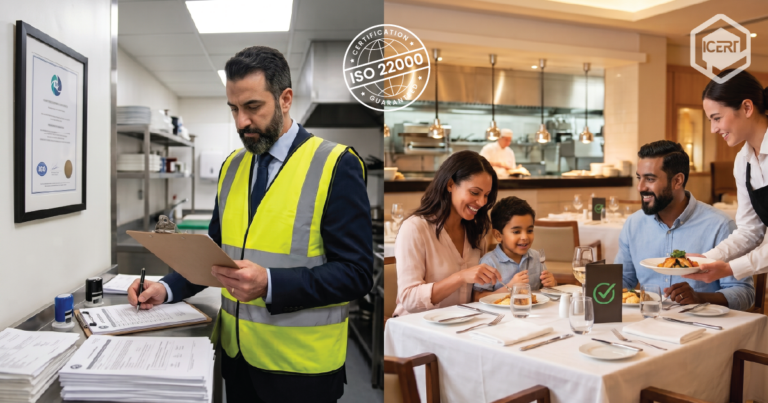
Consequently, acquiring an accredited ISO 22000 certification in UAE has evolved from a regulatory afterthought into a critical B2B baseline qualification. It is the definitive commercial trust signal that separates reliable food suppliers from high-liability vendors.
The Shift in B2B Procurement: Moving Beyond Regulatory Minimums
Local municipal regulations establish the legal floor for food safety—they are the minimum standards required to keep your doors open. However, enterprise buyers and major hospitality groups operate on a completely different risk curve.
When a five-star hotel conglomerate or a national supermarket chain contracts a food processor, distributor, or catering vendor, they are outsourcing a massive amount of operational risk. A single food safety failure upstream—such as an unmitigated allergen cross-contamination, a cold-chain breakdown, or a biological hazard—does not just harm the direct supplier; it destroys the end-brand’s reputation overnight.
As highlighted by global public health frameworks, including insights from the WHO Food Safety Fact Sheet, foodborne hazards are preventable through structured management systems that cover every link of the supply chain.
Recognizing this, corporate procurement committees across the region now use food safety certification GCC standards as a mandatory vendor filtering tool. If a supplier cannot demonstrate an internationally verified Hazard Analysis Critical Control Point (HACCP) system embedded within a comprehensive ISO 22000 framework, they are routinely locked out of lucrative commercial contracts.
Safeguarding Enterprise Reputation Against Large-Scale Failures
In the digital age, news of a food safety breach travels instantly. For a major regional food brand, a quality failure or public health incident can erase years of marketing investments and trigger catastrophic financial losses.
This is why B2B partners demand absolute transparency and accountability. Implementing ISO 22000 standards Dubai and across the emirates provides enterprise buyers with verifiable proof that your organization practices rigorous, systematic risk management.
A certified Food Safety Management System (FSMS) introduces robust operational controls that protect your business and your commercial partners against large-scale failures:
- Traceability and Recall Preparedness: Modern supply chains require end-to-end transparency. ISO 22000 enforces strict lot-tracking and traceability protocols, ensuring that if an anomaly occurs, it can be isolated and resolved immediately before escalating into a public crisis.
- Systemic Hazard Prevention: Rather than relying on sporadic manual checks, the standard establishes continuous monitoring at every critical control point, from raw material sourcing and warehousing to temperature-controlled transit and final delivery.
- Cross-Contamination Mitigation: In high-volume food processing and commercial kitchens, structural separation of allergens and raw-versus-cooked goods is vital. ISO compliance standardizes these physical and procedural workflows.
When you present a verified ISO 22000 credential to a prospective enterprise client, you are communicating a powerful message: Our operations are fortified against failure, and partnering with us carries zero reputational risk.
Navigating the Regional Regulatory and Commercial Landscape
Achieving and maintaining this level of operational maturity requires deep technical understanding and familiarity with the GCC’s unique supply chain dynamics. This is where partnering with specialized ISO certification consultants GCC becomes an invaluable asset for food industry enterprises.
Whether you are scaling your food distribution network through an ISO consultancy in UAE, establishing a processing facility with ISO consultancy in Dubai, or aligning manufacturing protocols via ISO consultants in Abu Dhabi, expert guidance ensures your management system satisfies both local municipal authorities and rigorous enterprise procurement guidelines.
Furthermore, forward-thinking food enterprises rarely operate in a single-standard vacuum. Many organizations integrate their food safety framework with complementary benchmarks, such as ISO 9001 certification in Dubai for overall quality management or working alongside specialized ISO 9001 consultants in UAE, to build a comprehensive Integrated Management System (IMS). This multi-standard approach signals absolute organizational excellence to the regional market.
The Broad Economic Impact: Why B2B Buyers Demand ISO Standards
The commercial advantages of holding recognized credentials extend far beyond risk mitigation. Across the UAE and the wider GCC, the food and beverage sector is experiencing rapid expansion, driven by tourism, population growth, and ambitious national food security strategies.
In this hyper-competitive market, suppliers with standard compliance capabilities often find themselves locked in price wars, competing on thin margins. Conversely, organizations that hold accredited credentials positioned through reputable ISO certification companies in UAE operate in a different tier. They win long-term vendor agreements, secure preferred supplier status with multinational hospitality brands, and command higher contract values because their operational reliability is pre-verified.
Moreover, industries that intersect with sensitive consumer needs—such as healthcare nutrition, infant food manufacturing, and specialized catering—frequently require multi-disciplinary compliance. For instance, pairing food safety frameworks with technical standards like ISO 13485 certification UAE or general ISO certification for IT services for automated supply chain tracking creates an impenetrable corporate profile.
Conclusion
In the demanding B2B commercial environment of the GCC, food safety compliance is no longer just about satisfying municipal inspectors or checking regulatory boxes. It is the foundational currency of supply chain trust.
By moving beyond basic compliance and implementing the structured, risk-mitigating framework of ISO 22000, food processors, distributors, and hospitality vendors can protect their partner brands, secure high-value enterprise contracts, and insulate their operations against reputational damage.
Don’t let missing credentials cost your business valuable enterprise tenders. Elevate your supply chain standards and position your brand as a trusted market leader today.
Ready to secure enterprise contracts and fortify your food safety standards? Contact ICERT Gulf today to schedule a comprehensive gap analysis with our expert team. Explore our core offerings on our Home page, discover our strategic consultancy services, or review our complete suite of certification solutions to start your journey toward unhindered regional growth.