
In the high-stakes industrial and commercial sectors of the United Arab Emirates and the wider Gulf Cooperation Council (GCC), operating expenses (OPEX) are under constant pressure. For facility managers, chief financial officers, and operations directors, utility bills, particularly electricity costs driven by year-round cooling and heavy industrial loads, represent one of the most volatile and burdensome line items on the corporate balance sheet.
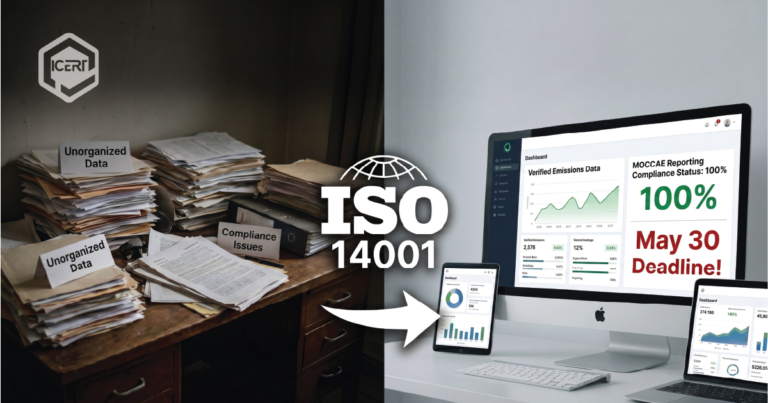
For years, corporate dialogues surrounding energy consumption remained trapped in an administrative silo. Energy management was routinely relegated to an annual “ESG checkbox”, a static report compiled to satisfy external regulators, check corporate social responsibility boxes, and gather dust on a shelf.
This narrow outlook is dangerously obsolete.
In today’s competitive market, viewing energy optimization merely through a regulatory compliance lens misses its true commercial value. Energy management is no longer about ticking administrative boxes; it is about Bottom-Line ROI and Cost Control. It is a rigorous, data-driven financial and technical strategy designed to slash soaring OPEX, eliminate systemic inefficiencies, and protect industrial profit margins from escalating utility tariffs.
Achieving ISO 50001 certification in Abu Dhabi and across the broader region is the definitive mechanism for transforming energy management from a passive cost center into a powerful engine for financial savings and resource optimization.
The Financial Reality: Moving Beyond the “ESG Checkbox”
The traditional view of energy auditing treats consumption figures as historical records. Organizations look backward at utility invoices, tally up total kilowatt-hours, and pay whatever price the market dictates.
However, modern finance and operations leaders understand that unmanaged energy use is direct capital leakage. Every unoptimized kilowatt consumed is wasted money evaporating through thermal inefficiencies, friction in aging machinery, and poorly balanced cooling loads.
When organisations implement a structured framework with the help of specialized energy management system consultants, they stop treating power as an uncontrollable fixed cost and start treating it as a variable that can be aggressively optimized.
By establishing precise Energy Performance Indicators (EnPIs) and real-time consumption baselines, technical teams can pinpoint exactly where energy is being wasted. Eliminating these inefficiencies yields immediate, measurable reductions in monthly OPEX, directly improving net profit margins.
Hard Bottom-Line Savings Through Systematic Optimization
The primary driver for adopting an energy management framework should never be abstract environmentalism alone, it must be financial performance. Implementing an ISO 50001 implementation UAE framework delivers tangible commercial returns through several direct mechanisms:
- Peak Load Shifting: Energy tariffs in the GCC often fluctuate based on peak demand hours. By restructuring industrial processes to operate during off-peak windows, facilities can capture substantial tariff discounts.
- Preventive Maintenance Savings: High energy consumption in motors, compressors, and chillers is almost always a symptom of mechanical wear, misalignment, or friction. Treating energy data as a diagnostic tool catches these issues early, preventing expensive equipment failures and emergency repairs.
- Resource Allocation Precision: Granular sub-metering allows businesses to calculate the exact cost of energy per unit of production, enabling more accurate product pricing and tighter cost accounting.
When energy is managed with the same rigor as raw materials or labor, the return on investment for the certification process is typically recovered within the first year of operation through direct utility bill reductions.
Battling Soaring OPEX During the GCC Climate Cycle
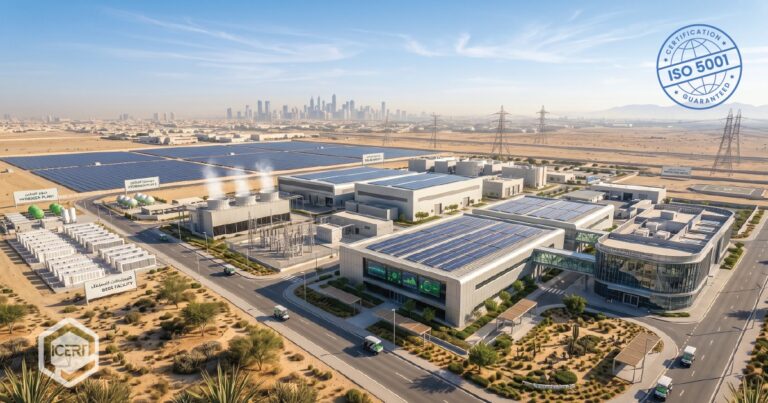
The climatic reality of the GCC introduces unique financial pressures. During peak summer conditions, the thermal load placed on commercial buildings, manufacturing plants, and processing facilities forces cooling and electrical infrastructure to work at maximum capacity.
Without a sophisticated energy management architecture, facilities bleed cash through uncontrolled energy waste. Chillers run continuously at inefficient speeds, electrical infrastructure generates excess heat, and operational overhead spikes dramatically.
This unoptimized energy drain severely damages profitability. ISO 50001 acts as a financial shield against this seasonal OPEX surge. By systematically mapping thermal loads and enforcing strict efficiency baselines, the standard ensures that equipment operates at peak efficiency curves, drastically lowering monthly utility expenditures when power demand is at its highest.
The Multi-Industry Commercial Imperative
While bottom-line savings are universally attractive, certain sectors within the UAE and GCC face severe financial exposure if energy costs remain unmanaged.
Manufacturing and Heavy Industry
In high-output manufacturing, energy is often one of the largest controllable operational expenses. A minor percentage drop in energy intensity translates directly into hundreds of thousands of dirhams in annual savings, giving cost-conscious firms a vital competitive edge in pricing.
Healthcare and Pharmaceuticals
Maintaining precise environmental controls is non-financial until a system failure causes product spoilage or regulatory penalties. Structured energy management protects sensitive inventories while optimising the heavy operational costs of 24/7 climate control.
Commercial Real Estate and Data Centers
For property developers and data center operators, power consumption dictates operational margins. Certified energy frameworks maximize tenant value and reduce overhead, transforming energy efficiency into a primary selling point for corporate clients.
Navigating Compliance with Regional and International Expertise
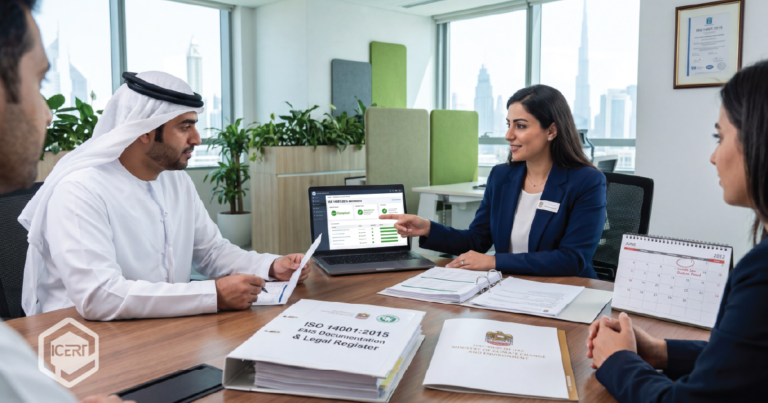
Unlocking these financial returns requires deep technical proficiency and an intimate understanding of the local economic climate. This is where partnering with experienced ISO certification consultants GCC becomes essential.
Navigating the nuances of ISO consultancy in UAE requires bridging the gap between global engineering standards and local municipal utility guidelines. Whether you are executing an ISO consultancy in Dubai or deploying complex infrastructural adjustments through ISO consultants in Abu Dhabi, expert guidance ensures your management system is tailored to maximize your financial return on investment.
Furthermore, forward-thinking organizations combine their ISO 50001 frameworks with ISO 9001 certification in Dubai or guidance from expert ISO 9001 consultants in UAE to create an integrated management system (IMS) that harmonizes financial quality, resource optimization, and operational efficiency.
Why Choose ICERT Gulf
As businesses across the region face rising operating costs and tightening margins, selecting the right strategic partner is critical. ICERT Gulf has established itself as a premier name among ISO certification companies in UAE, delivering clarity and measurable financial outcomes for over a decade and a half.
- 15+ Years of Expertise: We bring deep institutional knowledge of the GCC industrial environment, helping organizations identify cost-saving opportunities that generic consultants miss.
- 600+ Projects Completed: Our proven implementation methodology ensures seamless integration without disrupting ongoing commercial operations.
- 500+ Satisfied Customers: Our clients rely on our dedicated industry experts to turn compliance frameworks into bottom-line profitability.
- Regional and International Outlook: We combine rigorous international standards with intimate local market insight, positioning us as a trusted ISO certification provider across the entire GCC.
Whether you require specialized ISO certification for IT services, medical-grade compliance via ISO 13485 certification UAE, or comprehensive multi-standard implementation from a trusted ISO certification company, ICERT Gulf provides the end-to-end support necessary to protect your profit margins.
Conclusion
Energy management is no longer a peripheral administrative task or a seasonal checkbox for annual reports. In the demanding economic climate of the GCC, it is a core financial strategy for cutting soaring OPEX and driving bottom-line ROI.
By moving past the “ESG checkbox” mentality and embracing the structured, revenue-protecting framework of ISO 50001, forward-thinking organizations can turn utility expenses into a managed, optimized asset.
Don’t let unmanaged energy costs erode your profit margins. Take control of your resource consumption and build a financially resilient enterprise today.
Ready to slash your OPEX and maximize your bottom-line ROI? Contact ICERT Gulf today to schedule a comprehensive cost-reduction consultation with our expert team. Explore our core offerings on our Home page, discover our strategic consultancy services, or review our complete suite of certification solutions to start your journey toward unhindered regional growth.