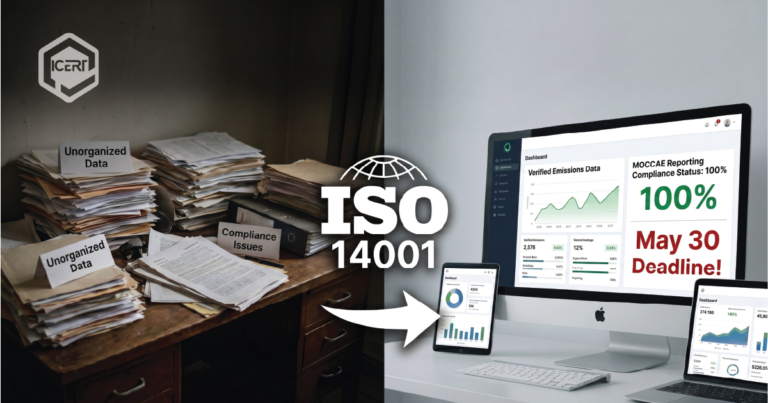
The countdown has officially entered its final phase. As of today, March 19, 2026, businesses across the United Arab Emirates are standing at a regulatory crossroads. The grace period for Federal Decree-Law No. 11 of 2024 (the “Climate Change Law”) is rapidly evaporating. With the May 30, 2026, deadline for mandatory greenhouse gas (GHG) emissions reporting just weeks away, the transition from voluntary sustainability to legal obligation is complete.
For the modern CEO, Operations Manager, or Sustainability Lead, this is no longer a matter of “corporate image.” It is a matter of legal survival and financial health. Non-compliance is no longer an option, as the Ministry of Climate Change and Environment (MOCCAE) has established a clear framework for administrative fines that can reach up to AED 2,000,000.
At ICERT Gulf, we understand that the biggest challenge facing UAE firms today isn’t the desire to be “green”, it is the ability to produce accurate, auditable, and transparent data. This is where the synergy between ISO 50001 (Energy Management) and the new federal mandates becomes your greatest competitive advantage.
The 2026 Regulatory Reality: Federal Decree-Law No. 11
The UAE has solidified its position as a global leader in climate action through the UAE Net Zero by 2050 Strategic Initiative (External Link). However, the implementation of Federal Decree-Law No. 11 has moved the goalposts.
Unlike previous years where carbon footprinting was a “bonus” for annual reports, the 2026 landscape requires:
- Mandatory Measurement: Every significant industrial and commercial entity must track its emissions.
- National Carbon Registry: Large emitters must register their data in a centralized federal system.
- Verified Reporting: Reports must be submitted to MOCCAE (External Link) by the May 30 deadline.
If your organization is currently scrambling to gather utility bills and fuel receipts, you are at risk. This fragmented approach leads to data gaps that federal auditors will not overlook. To bridge this gap, businesses are increasingly turning to a professional ISO consultancy in uae to implement a robust Energy Management System (EnMS).
How ISO 50001 Acts as Your “Compliance Engine”
ISO 50001:2018 is the global standard for energy management. While its primary goal is to improve energy performance, in the context of the UAE’s 2026 mandates, it serves as the ultimate data collection and verification tool.
When you work with an experienced ISO certification provider, ISO 50001 allows you to:
1. Establish an Accurate Energy Baseline
You cannot report what you do not measure. ISO 50001 requires organizations to develop an Energy Baseline (EnB) against which performance is measured. This baseline provides the historical context needed for the MOCCAE reporting requirements, ensuring your “Starting Point” is scientifically sound.
2. Identify Significant Energy Uses (SEUs)
The UAE Climate Change Law focuses on where the most damage is being done. ISO 50001 forces your facility to identify SEUs—the specific machinery, cooling systems, or processes that consume the most power. This granular data is exactly what is required for the tiered reporting structures of Federal Decree-Law No. 11.
3. Automate Data for the National Carbon Registry
One of the biggest hurdles for ISO certification consultants GCC is helping clients move away from manual spreadsheets. An ISO 50001 framework encourages the use of digital monitoring and targeting (M&T) systems. This means that when the May 30 deadline arrives, your data is already formatted, verified, and ready for upload to the National Carbon Registry.
Decarbonising the Bottom Line: The Financial Case
“Decarbonization” is often viewed as a cost center, but through the lens of operational excellence, it is a profit driver. In the GCC, where cooling and industrial energy costs represent a significant portion of OpEx, efficiency is synonymous with profitability.
By implementing ISO 50001, firms in Dubai and Abu Dhabi are seeing:
- Direct Energy Savings: Average energy performance improvements of 10% to 30% within the first two years.
- Avoidance of Fines: Safeguarding the balance sheet against the AED 2 million penalties for non-compliance.
- Lower Insurance Premiums: As climate risk becomes a factor for UAE insurers, having an accredited ISO certification in uae can lead to lower premiums.
For those already working with ISO 9001 consultants in uae, adding ISO 50001 to your Integrated Management System (IMS) creates a “Quality + Sustainability” culture that appeals to international investors and high-value government tenders.
The Urgency of the May 30 Deadline
Why is there so much focus on May 30, 2026? This date marks the end of the “Adjustment Period.” After this date, MOCCAE inspectors are authorized to begin audits of private and public sector entities.
If you are a logistics firm in JAFZA, a tech hub in Masdar City, or a manufacturing plant in ICAD, you are under the microscope. Seeking an ISO consultancy in Dubai or ISO consultants in Abu Dhabi today is the only way to ensure your facility is “Audit-Ready” before the summer heat, and the regulatory pressure reaches its peak.
Why Choose ICERT Gulf for Your Sustainability Journey?
At ICERT Gulf, we bring clarity to the complexity of managing your ISO certification efforts. We are a one-stop-shop for a wide range of certifications, and we pride ourselves on having a deep functional and industrial knowledge of the GCC market.
Our Credentials Speak for Themselves:
- 15+ Years of Expertise: We have evolved alongside the UAE’s regulatory landscape.
- 600+ Projects & 500+ Satisfied Customers: We have assisted companies across all sectors in achieving excellence.
- Integrity & Transparency: We provide open, honest communication about what you need, and what you don’t, to meet the 2026 mandates.
Whether you need ISO 9001 certification in Dubai to streamline your processes or specialised ISO certification for it services to protect your digital infrastructure, we are passionate about the problems that are important to you. Our local presence with an international outlook ensures your ISO certification in GCC states is recognised worldwide.
The Road to May 30: Your 10-Week Action Plan
As a premier ISO certification company, we recommend the following immediate steps:
- Immediate Gap Analysis: Identify where your current energy data falls short of MOCCAE requirements.
- Appoint a Sustainability Lead: Use ISO certification consultants GCC to train your internal team on GHG accounting.
- Digitize Your Meters: Move away from manual readings to ensure data integrity for federal reporting.
- Seek Accredited Certification: Ensure your ISO certification in Abu Dhabi or Dubai is issued by an accredited ISO certification provider to ensure it is accepted by UAE authorities.
Turning a Mandate into a Milestone
The May 30, 2026, deadline is not just a hurdle; it is a catalyst. It is an opportunity for UAE businesses to prove their resilience, efficiency, and commitment to the future of the nation. By linking ISO 50001 to your mandatory climate reporting, you aren’t just “checking a box”, you are decarbonising your bottom line and securing your place in the future of the GCC economy.
Don’t let the deadline catch you unprepared. The cost of delay is far higher than the cost of compliance.
Is your energy data ready for federal scrutiny?Contact ICERT Gulf today for an urgent consultation. Let our industry experts guide you through the complexities of Federal Decree-Law No. 11 and ensure your organization meets the May 30 deadline with confidence and excellence.